
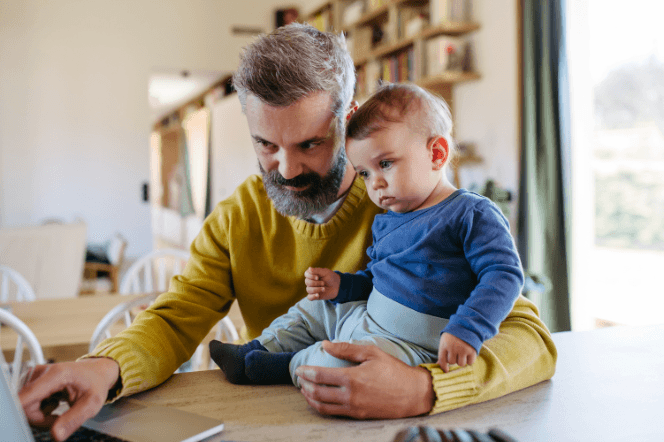
Toddler Tantrums with Dad: Why They Happen and How to Handle Them Without Losing Yourself

 Facebook
There is a specific moment that tests a father’s emotional capacity like nothing else: your toddler drops to the floor in the middle of a store, screaming, kicking, refusing to move, and suddenly every pair of adult eyes in the room seems to turn toward you. In that moment, it does not feel developmental. It feels personal. It feels like failure. It feels like judgment.
Many fathers search for “how to handle toddler tantrums as a dad” not because they do not understand what a tantrum is, but because they feel something rising inside themselves when it happens. Frustration. Embarrassment. Anger. Helplessness. And sometimes a quiet fear that they are not cut out for this stage of parenting.
But toddler tantrums are not signs of bad parenting. They are signs of neurological growth.
Why toddler tantrums happen more with dad
One of the most common patterns fathers notice is that tantrums seem more intense or frequent when they are present. A child who was relatively calm with one caregiver suddenly becomes explosive with dad. It can feel like selective defiance. Developmental psychology offers a different interpretation.
The prefrontal cortex, which regulates impulse control and emotional management, is still immature in toddlers. According to the Center on the Developing Child at Harvard University, young children rely heavily on caregivers to co-regulate their emotions because their brains are not yet capable of managing overwhelming feelings independently.
When a toddler feels safe with a parent, especially one associated with stimulation and play like many fathers, emotional expression can intensify. Safety invites expression. A child who feels secure will often release stored frustration more openly.
This dynamic overlaps with themes explored in Why Toddlers Behave Differently With Dads, where testing is framed not as rejection, but as trust.
What a tantrum actually is
A toddler tantrum is not a strategy. It is not manipulation in the adult sense. It is a nervous system overload.
When toddlers experience frustration, disappointment, hunger, overstimulation, or fatigue, their stress response activates quickly. Without mature emotional regulation systems, that activation spills outward through screaming, crying, hitting, or collapsing onto the floor.
The American Academy of Pediatrics explains that tantrums are developmentally normal between ages 1 and 4 and are closely tied to limited language skills and immature impulse control.
For fathers, understanding this intellectually does not always prevent emotional reaction. The noise, the public exposure, the unpredictability can activate your own stress response. And that is where most escalation begins.
Why dads often escalate unintentionally
When a tantrum happens, especially in public, fathers can feel pressure to regain control quickly. Volume increases. Commands become sharper. Physical posture stiffens. The goal becomes stopping the behavior rather than regulating the moment. But emotional intensity rarely reduces emotional intensity. It amplifies it.
In fact, emotional mirroring is common in parent-child dynamics. When a father’s stress spikes, a toddler’s stress spikes further. Regulation must enter from the adult first.
This is closely connected to the cycle described in Anger Issues in Dads, because toddler tantrums often trigger deeper patterns in fathers who are already stretched thin.
The tantrum is the spark. The father’s accumulated stress is the fuel.
What actually helps in the middle of a meltdown
The most effective approach to toddler tantrums is less dramatic than most advice suggests. It involves lowering your own nervous system activation before attempting to control your child’s behavior.
Getting physically lower to their eye level. Reducing your voice rather than raising it. Offering simple acknowledgment like, “I see you’re upset,” without immediately correcting the behavior.
This does not mean permissiveness. It means co-regulation. When the emotional wave passes, boundaries can be re-established calmly. But trying to reason with a dysregulated toddler rarely works in the peak of the tantrum. Long-term listening improves when short-term escalation decreases.
The long-term impact of how you handle tantrums
Children do not remember every meltdown. They remember patterns of safety. Repeated exposure to calm, steady responses during emotional storms builds internal regulation over time. Research consistently shows that children develop stronger emotional resilience when caregivers model consistent regulation rather than reactive intensity.
This developmental scaffolding is deeply connected to secure attachment where daily responsiveness shapes long-term trust. Every tantrum is not just chaos. It is practice. Practice for your child’s developing brain. And practice for your emotional endurance.
When it feels like too much
If toddler tantrums consistently push you toward anger or shame, that does not mean you are a bad father. It may mean you are exhausted. Overloaded. Carrying stress from other parts of your life.
Sometimes the work is not just about handling the tantrum better. It is about addressing what is draining you outside of it.
Children do not need a father who never feels frustrated. They need a father who learns how to return to calm.
Tantrums are loud. They are inconvenient. They are socially uncomfortable. But they are temporary.
The way you respond to them quietly shapes something much longer lasting than the noise itself.
Similar Blog

Why Your Toddler Won’t Listen to Dad
Many fathers feel frustrated when their toddler ignores them but listens to others. This article explains why it happens and how to respond without damaging connection.
Read more
Why Toddlers Behave Differently With Dads | Father–Child Bond Explained
Many fathers notice their toddler behaves differently with them than with their mother. This article explains why that happens, what it says about attachment, and how dads can build a strong emotional bond during early childhood.
Read more
Why Kids Open Up More to Some Fathers Than Others
Children don’t open up because they’re told to. They open up when experience teaches them it’s safe. This essay explores why some kids talk freely with their dads and how everyday reactions quietly shape emotional openness.
Read more